

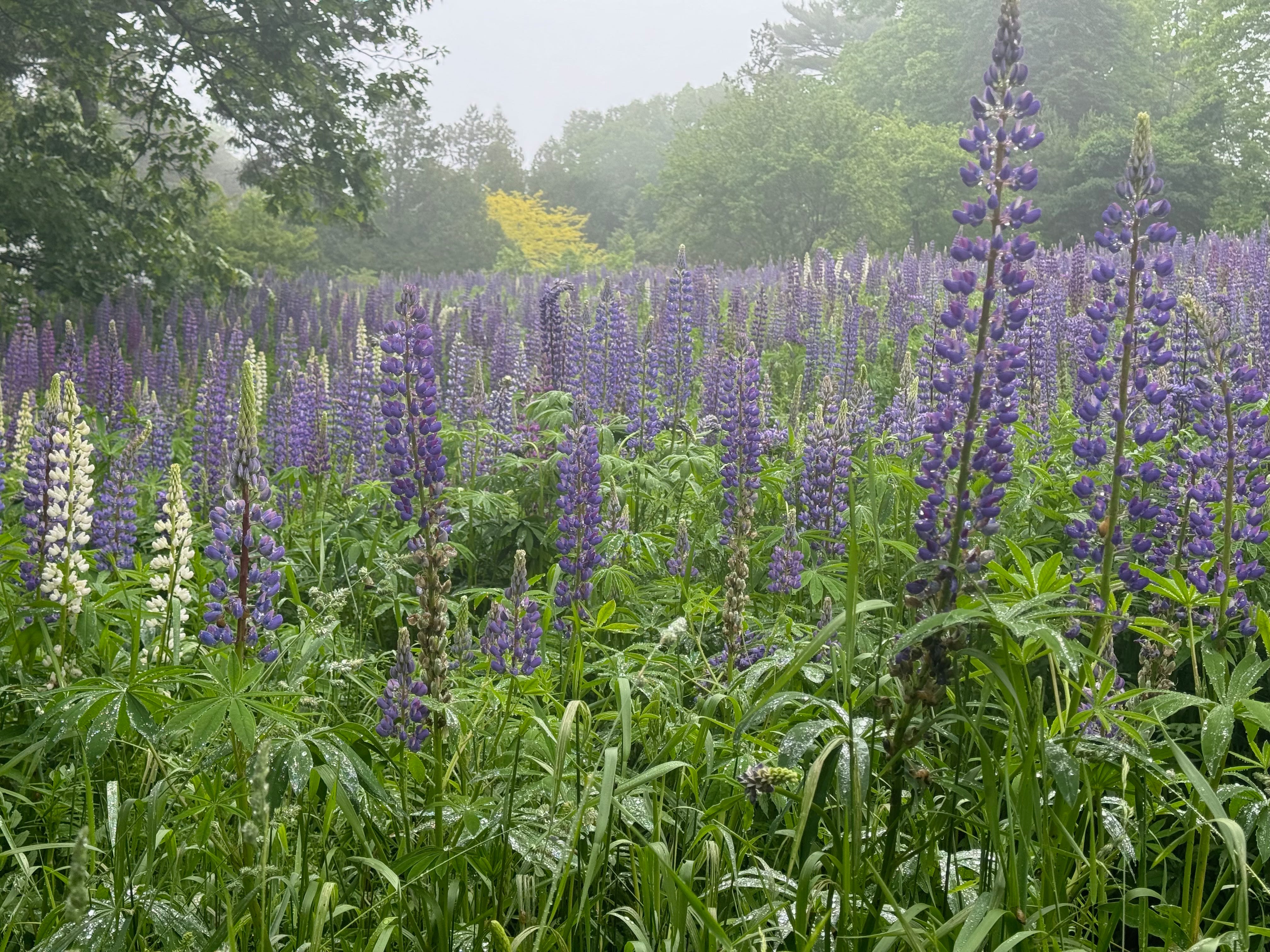
It’s a real sign of summer: fields and fields of lupine, mostly summer-sky blue but dotted with white and occasional pink spears, all up and down the coast of Maine and deep into the interior. The first spike sighted always makes me smile but the rolling fields that blossom along roadsides and meadow edges leave me slack-jawed at the spectacle. Unfortunately, almost all of this is what’s called big-leaf lupine (Lupinus polyphyllus), as the Maine Botanical Gardens website informs us, and, gorgeous as it is, it is an aggressive invader that is pushing out our native sundial lupine (Lupinus perennis), which is on the verge of extinction. If you’re interested in contributing to the revival of native lupine, the Wild Seed Project is a good place to start.
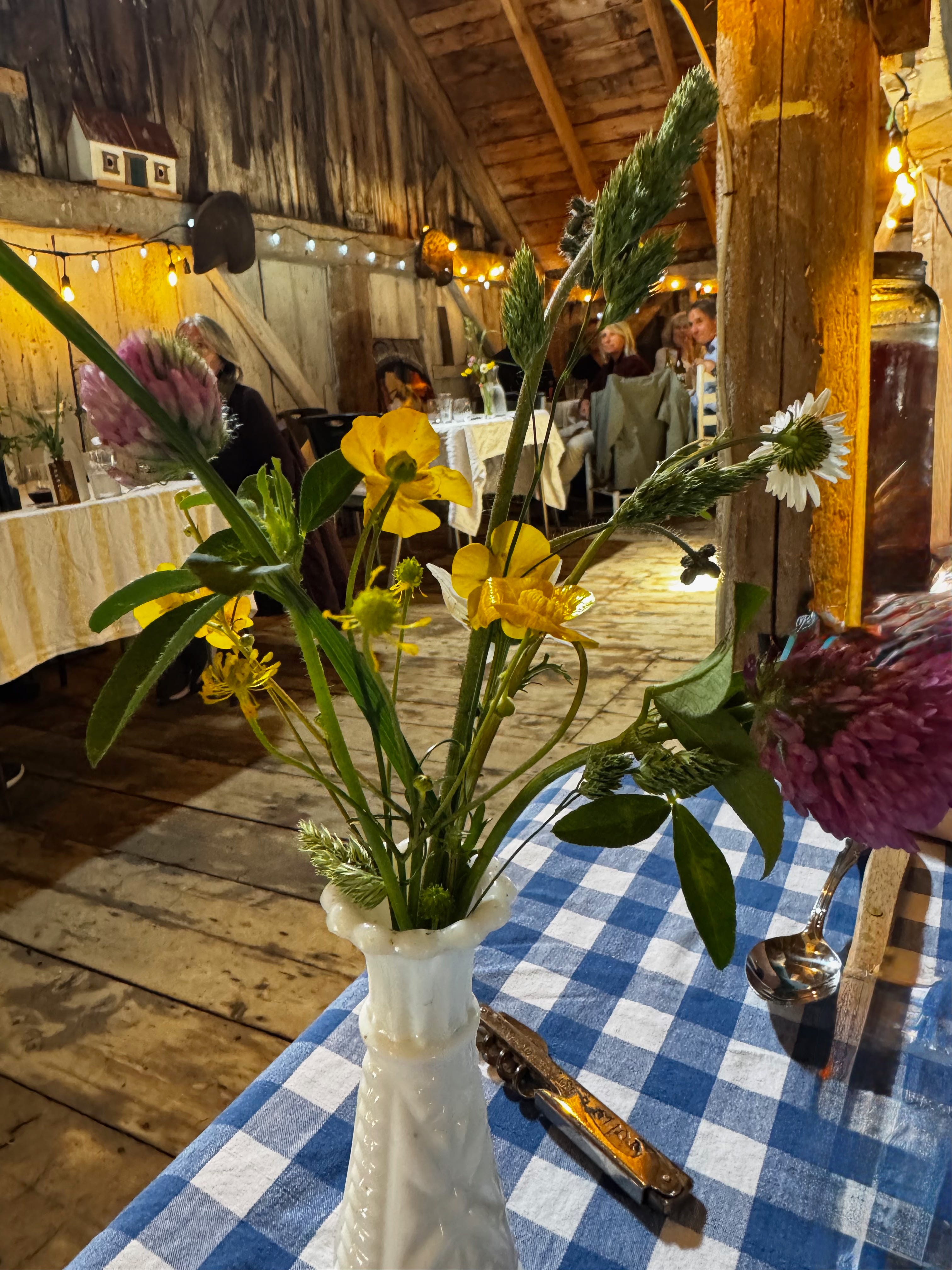
And speaking of connections, which I am about to do, this was the table decor at a Sunday lunch recently at East Forty Farm, all grasses and flowers gathered from the meadows where their herd of Jerseys graze in mammalian contentment. These cows are fed not just on alfalfa but on a complex combination of flowers (daisies, buttercups), legumes (clover, vetch), and an assortment of other natural vegetation that all goes to make a diet for rich and fragrant butter and cheese.
Several events in recent weeks have led me to think more about the networks that connect us all, the threads of community and humanity, the links that bind us to a place, or a person, or a group of people. One was a devastating explosion in a small rural community near my Maine home, the other a death, not unexpected but deeply mourned around the world. And finally, a new connection, established through that great network of Substack.
I’ll start with the huge explosion that tore through a historic lumber yard not far from where I live on the coast of Maine. Local fire crews were battling a quickly spreading blaze when a silo packed with wood chips and sawdust exploded like a horrific bomb, instantly killing one young fireman and injuring scores of other first responders, many critically. Fire brigades, emergency medical teams, and life-flight helicopters responded from all across the area, rescuing the injured, transporting them to nearby hospitals, which were quickly overwhelmed, then to burn units as far away as Portland and Boston, even as ground crews continued to struggle with the spreading fire.
It was an overwhelming response but not unexpected in Maine where, we like to say, for all our size, we’re just one big small town. When something goes wrong, and in this case something went majorly wrong, there’s an immediate outpouring of help as people pitch in, rush to the scene, ready to assist, and in the aftermath to contribute whatever can be scraped together to cover the enormous costs to individuals, families, enterprises, and communities. Finally, in the end, to help with the healing—with money, with food, but most of all with arms, both actual and figurative, wrapped around each other. Sometimes what the world needs most is a warm and comforting embrace, a connection.
What this horrific accident told me, the lesson I took away, is this: For all our constant wrangling and bickering (we are in the midst of an intensely disputatious electoral season), for all our backbiting, our finger pointing, our accusations of bad faith, we are still a community, our ties are still strong, our links are unbroken, at least for now, and when tragedy happens, we don’t question motive, we just move to help.
Those networks, it turns out, don’t just connect humans one to another, mind to mind, soul to soul to soul, they exist also in the natural world and in places where most of us had never expected it or experienced it—that is, in the world of plants and trees and growing things, from stately elms and pine trees to the crowded and often voluptuous world of the understory to the mycelium that stretches below the surface and constantly vibrates with messages, transmitted, unseen, among beings. There’s some comfort, at least for me, in the thought of that unbreakable connection.
Another network that ties us together was forged by a remarkable visionary, a man who died last month but who had what I hope will be a lasting impact. That man was Carlo Petrini who forged the worldwide network called Slow Food. Others have written about him, how they first met him, how they knew him or worked with him, but I think his memory will be strongest in some of the most obscure parts of the globe where, perhaps, Petrini himself never set foot and yet his ideas resonate, ideas about food and its importance to those who grow it, cultivate it, create it, cook it, and share it. Food, Petrini recognized, is nourishment on many different levels from the physical to the spiritual, and it is a vital part of the network that keeps us connected to one another.
I think my friend Marjorie Shaw, now on Substack at insidersitaly@substack.com (and I urge you to subscribe and read Marjorie regularly if you care about Italy)--Marjorie said it best in her tribute to Petrini: “He understood . . . that food was not an isolated cultural domain, but a concentration of labour, ecology, inequality, and power. And while he was deeply rooted in and attached to the Langhe, in Piedmont, he was as at home speaking to a Napa Valley farmer as he was to an English prince as he was to a rural community of women in Peru. ‘Sediamoci a tavola’, he would say. Let us sit down at the table.”
Petrini, in his genius, recognized what connects us all, because, Marjorie notes, through Slow Food and its sister organization Terra Madre, he “created a living network connecting small-scale producers, indigenous communities, cooks, and academics across more than 150 countries, . . . held together by the conviction that, despite enormous challenges, food systems could still be rebuilt from the ground up.”
Food is connected to place, and place is connected to memory, and memory is what ties us to each other—the network, again, that connects us all.
Substack is developing into just such a network—and I’m speaking now only about food, although I recognize that there are many networks, often braided together, on Substack—people who care about the arts, or music, or 18th century English literature, or basketball or UFC or jazz or-- well, you get the picture. One of the great pleasures I’ve had as a contributor is that very business of connecting. Readers have become friends and long-lost friends have become readers, but there has also been a sense of re-connection with the world of food writers, those of us who make a living, slender as it is, by writing about food. With the disappearance of major food magazines and extended food sections of important newspapers, I’ve lost a sense of being part of the world that cares deeply about what we eat, where it comes from, how it’s prepared, and what new and old things we can do with it. So Substack helps a lot.
Last week I met a new friend from Substack, Domenica Marchetti, who writes prolifically about all things Italian, but especially about food. Traveling in Maine to promote her delightful new book, Italian Cookies:
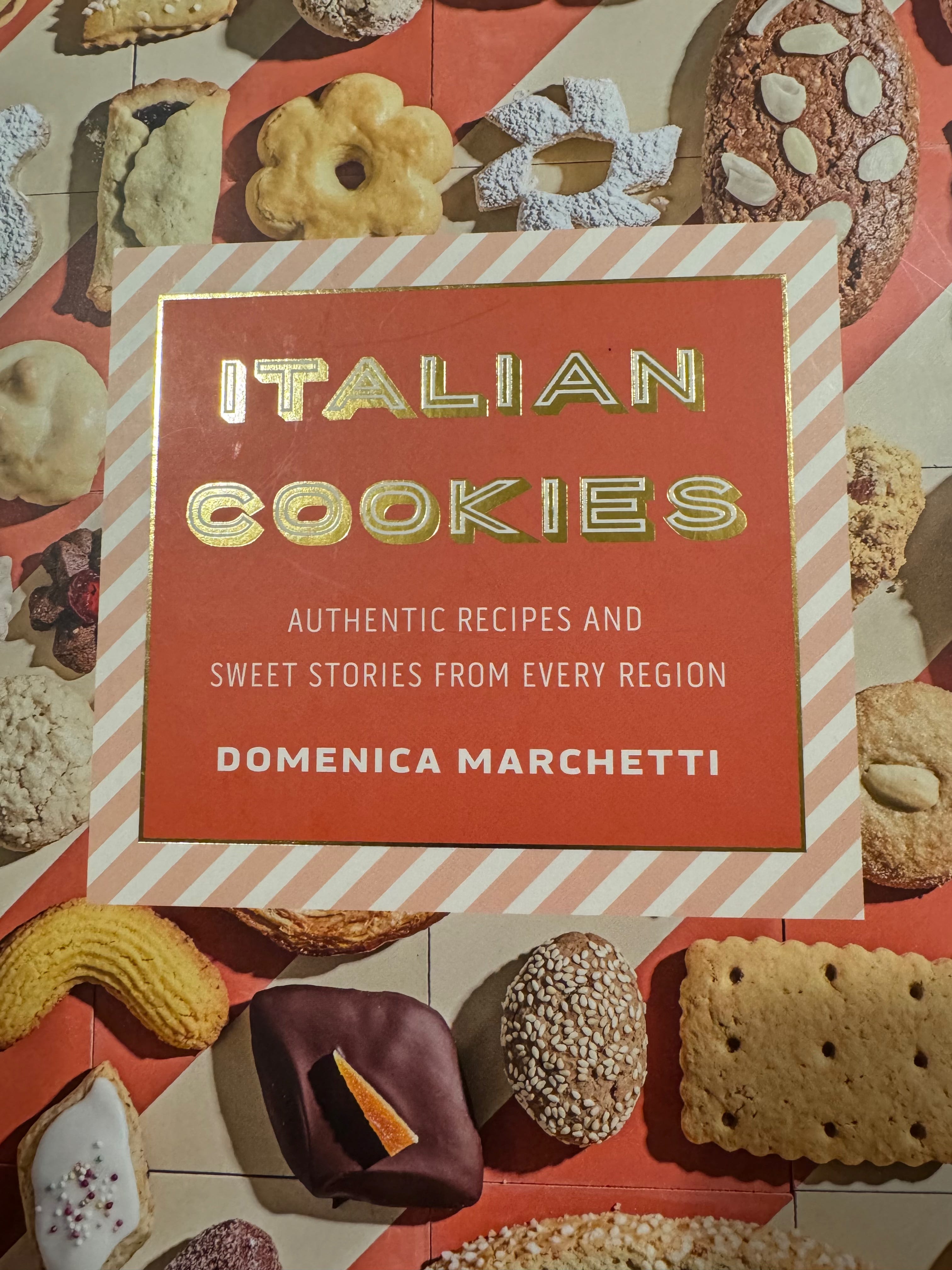
It’s a wide-ranging compilation through all the magnificently varied world of Italian cookies, from the familiar biscotti di Prato to the exotic to the truly unknown except perhaps in some small corner of Italy undiscovered by international travel where Domenica has scoped it out. She is italiana genuina, cento per cento, as we say, and has written several other books about Italian cuisine. Among them, my all-time favorite is Preserving Italy, which, like the cookie book, takes a pan-Italian look at all the multitude of ways that Italian cooks and chefs keep the harvest.
Domenica broke away from her book tour for lunch—not on the kitchen porch because it was still too chilly, but around the kitchen table. (Since you asked, I served a cold sorrel soup, using fresh sorrel from the garden, and lobster-potato salad with a mustardy vinaigrette, served on red Napa cabbage, a new find from the farmers market.)
So what did we talk about over our long lunch? Changes—in Italy, in Italian food and travel, the struggle to preserve culture and its hallmark cuisine, the old ways of doing things, the invasion of new ideas and products, and the balance that Italians struggle to maintain between national and regional identity, so strongly tied to food traditions, versus a kind of xenophobic defense of People Like Us. Nationalism can be as ugly as racism and Italians are not innocent of either, as communities seek to ban invasive species like kebab shops and curry houses. And yet, there is so much to be valued, as Carlo Petrini knew more than anyone, in the strong traditions that have been handed down, often over generations. Connection or distinction? It’s a conundrum.
Catch up with Domenica on her Substack page, Buona Domenica, where you’ll also find very sage wine advice from her husband Scott Vance.
I loved all the recipes in Italian Cookies and tried several, including a favorite from Venice, the cornmeal (think polenta) cookies called zaletti. But when I spied the recipe for reginelle, a lean sort of shortbread that is distinctively coated with sesame seeds, I leapt into it. Reginelle come from Sicily, not surprising given the Arab influences on Sicilian food—and the Arab love for sesame in all its guises. So far, so good. But what swept me up was my memory of a favorite pastry-coffee shop in Manhattan’s East Village, Veniero’s of venerable reputation. There the cookies are called biscotti regina and are said to be, inevitably, a favorite of Queen Margherita of Savoia who must have been enormous if she consumed all the foods that are attributed to her (i.e., pizza margherita, q.v.). But a better story, from the Veniero’s website, has to do with Frank Sinatra, a huge fan of the regina biscotti—but he liked them toasted, it was his secret to make a good thing even better.
So of course I put the reginelle I’d made for our lunch into the toaster oven for just a few minutes to turn them even more golden and crisp. And you know what? Old Blue Eyes was right, and Domenica agreed with me.
Following is the recipe for Domenica Marchetti’s reginelle, which are delicious, toasted or not. Paid subscribers have access to it. For the rest, you’ll have to become a paying subscriber—or buy Domenica’s cookbook.
Or why not do both?
